Wednesday, January 23, 2013

Illusion & Authenticity

" Thus, only when we have lost sight of way-making is there excellence, Only when we have lost sight of excellence is there authoritative conduct, Only when we have lost sight of authoritative conduct is there appropriateness, And only when we have lost sight of appropriateness is there ritual propriety.
As for ritual propriety, it is the thinnest veneer of doing one’s best and making good on one’s word,
And it is the first sign of trouble. “Foreknowledge” is tinsel decorating the way, And is the first sign of ignorance. It is for this reason that persons of consequence:     Set store by the substance rather than the veneer     And by the fruit rather than the flower.     Hence, eschewing one they take the other."

Ames, Roger; Hall, David (2010-05-12). Dao De Jing: A Philosophical Translation (Kindle Locations 755-759). Random House Publishing Group. Kindle Edition.
In the Ni-family Tai Chi style that I teach there are 108 postures that can be divided into two sections - a 58 movement 'Yin' section and a 50 movement 'Yang' section. Each posture is associated with both a common name and an underlying poetic meaning. Many of the posture meanings come from the Taoist classic 'The Tao Te Ching', and are paradoxical in nature. This is especially  true of the postures that comprise the early part of the 'Yin' section. A key theme is that things may not be as they seem to be on superficial observation.

For example early in the form there are postures with meanings such as, 'Exposition of the Mystery', 'The Great Straightness seems Crooked', 'The Great Fullness Seems Empty, 'Empty and yet Productive', 'Great Skill Seems Clumsy', and 'To be Curled is to be Straight'.

We know from physics that there are levels of reality that are quite different from what we perceive on a surface level inspection. Chairs seem to be solid objects, and they are at one level of perception. Wooden chairs however are made of cells, which are made of molecules, which are made of atoms. Atoms are mostly space with a nucleus in scale the size of a golf ball within the empty space the size of a football stadium. We call the electrons that orbit the nucleus 'particles', but they are more accurately points in space that are a special case of the electron field. Similarly the protons in the nucleus are made of different types of 'quarks'. Most of the mass in protons comes from the forces ( 'gluons' ) that hold quarks together, and like an electron each quark is just a special case of it's respective quark field. Fundamentally it could be said there no 'things', just relations between fields.

In order to navigate the world we need shortcuts. It is not possible to conceive of all the relational interactions that underlie our perceptions. Thus we have developed heuristics that bias the way we perceive 'things'. These heuristics are generally useful, but can sometimes mislead us. Visuals illusions can point this out. This web site presents many interesting examples with dynamic visuals. Here are a few basic examples, but I recommend visiting the site the see the full effects.


The Great Straightness Seems Crooked? All the lines are actually parallel and each square equal.


Copyright A.Kitaoka 1998


 The Great Fullness seems Empty? The triangle that appears on top is not drawn.

Kanizsa’s Triangle


 Another interesting one - Squares 'A' & 'B' actually exhibit the same degree of brightness.

Adelson’s  “Checker-shadow illusion”. ©1995, Edward H. Adelson

Also - The two tabletops are the same dimensions.

Shepard’s “Turning the Tables". Shepard RN (1981) Psychological Complementarity
Shepard RN (1981)
Shepard RN (1981)
Shepard RN (1981) Psychological complementarity
Shepard RN (1981) Psychological complementarity.


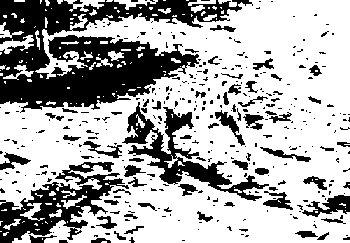
Sometimes expectations can be useful:
www.MichaelBach.de 2004

It would be hard to see the "Dalmation dog" in the figure above if you were not looking for it.

The downside is that our expectations sometimes lead us to see things that are not there. I think we also often miss the beauty of things when they occur in context that departs from our expectations. An elegant example of missing beauty out of context is demonstrated from a recent incognito performance depicted in this video, and in this must read article. As documented the celebrated violinist Joshua Bell performed for free on a 3.5 million dollar violin, yet was mostly ignored by those passing by who were too preoccupied to pay much notice. From the article:

"Watching the video weeks later, Bell finds himself mystified by one thing only. He understands why he's not drawing a crowd, in the rush of a morning workday. But: "I'm surprised at the number of people who don't pay attention at all, as if I'm invisible. Because, you know what? I'm makin' a lot of noise!"
He is. You don't need to know music at all to appreciate the simple fact that there's a guy there, playing a violin that's throwing out a whole bucket of sound; at times, Bell's bowing is so intricate that you seem to be hearing two instruments playing in harmony. So those head-forward, quick-stepping passersby are a remarkable phenomenon"
Another very interesting example of the strange ways that our expectations impact our conceptions of authenticity can be found in the ethically questionable, yet nevertheless interesting and informative documentary by Vikram Ghandi. The name of  the documentary is Kumaré, and this article by Erik Davis describes it nicely.As Davis details:
"Gandhi (his real name) was born in New Jersey and is an alumnus of Columbia University. But in the film he impersonates a long-haired, orange-robed, heavily accented Hindu guru called Sri Kumaré for months on end, gathering a small New Age flock that then witnesses its teacher’s shocking ‘Great Unveiling’ at the close of the film. Gandhi’s experiment is essentially a cruel sceptic’s prank, designed to expose the exotic projections and gullible fantasies animating today’s spiritual seekers."
Prior to his unveiling Gandhi has one primary message for his followers; he is not to be seen as a guru but as an illusion. The true guru is to be found within oneself. This presents an interesting paradox. As Davis puts it:

"Whereas many yogis and other spiritual teachers are arguably more ‘authentic’ in their presence and practice than in their often clichéd rhetoric, Kumaré is most truthful when proclaiming his own status as an illusion. Earnest spiritual teachers, even flawed ones, also want to wake up their students, whereas the awakening of Kumaré’s students to the truth of his illusion becomes, for Gandhi, something of a problem."

Gandhi  is being truthful when he proclaims Kumaré’s guru image an illusion. His followers see this as a great insight, but the insight remains linked to Kumaré’ image as a guru. Does the insight change when Gandhi reveals his deception? Does the revelation render the insight his followers experienced to be more or less authentic?

Yet another example is illustrated in this study, that details the effect that price has on the taste experiance of wine. The study assigned price labels to bottles of wine. The bottles of wine were identical but the price labels ranged from 10 to 90 dollars. Particpants were asked to rate the wines (which they thought were different ) and they also had thier brain activity captured by FMRI while doing the tasting. As expected the participants preferred the wine when a more expensive label was attached to the bottle. Interestingly the FMRI results indicated that this was not a simple cognitive bias preference, but that the particpants actually experienced more pleasure when sipping the same wine with a higher price tag.

The questions relate closely to placebo effects which I plan to post on at some point with reference to the work of Ted Kapchuk.

Friday, January 18, 2013

Hemisphere Asymmetry & Complementary Constraint


It has been estimated that the human brain contains 80-100 billion neurons.
 Each of the 1011 (one hundred billion) neurons has on average 7,000 synaptic connections to other neurons.
Each neuron can be excitatory or inhibatory.  The philosopher Dan Dennett decribes individual neurons:
"not as dutiful slaves or as simple machines but as agents that have to be kept in line and that have to be properly rewarded and that can form coalitions and cabals and organizations and alliances"
How does this massive number of potential signal transmissions form these alliances, and what are the underlying physical and organizational structures that allow for the sense of a single coherent mind to eventually emerge from this interconnected web of electrical signals ?
The brain can be conceptualy divided at many levels. A rational decision making process depends on the the frontal cortex and the limbic system mutually constraining each other. A primary (top-down) function of the  frontal cortex (often called the executive function) is thought to be inhibatory, helping to keep the more primitive and emotional limbic system under control.  Similarly the frontal cortex depends on its connection to the feelings and emotions that rise up from the limbic system to give its decisions a sense of proportion.

Much of the competition and coordination between these electrical signals occurs below the conscious surface within the autonomic nervous system. For example, the unconscious process of multiple negative feedback systems orchestrated primarily by the hypothalamus is responsible for maintaining a state of homeostasis in the body. These processes are also examples of mutally constraining systems.
At its most basic structural division the brain is divided into a left and right hemisphere separated by the corpus callosum which allows the two hemispheres to communicate.  An asymmetry in the functions of the two hemispheres will be the focus of this post. While there has been much over-simplification for the roles of the two hemispheres in the public arena there some fundamental and fairly consistent differences in the way they allow us to perceive the world. This basic structural and functional division very often takes the form of complementary constraint .

Cartoon Depicting Locally Compartmentalized Left Brain vs Globaly Holistic Right Brain.
Image from mattovermatter.com             
Thinking about Complementary Correspondences –


Left Hemisphere Dominance
Right Hemisphere Dominance
General
Language (but RH for metaphors & prosody).
Literal, certainty.

Dopamine
Music, Spatial awareness. Sets the context for understanding. Uncertainty.
Behavior
Approach
Withdrawal
Emotions
Generally positive, also anger
Unconscious Emotions (&here)
(in response to faces)
Conscious Negative Emotions
(in response to words)
Thinking
Convergent (knows what it knows) – Likes to analyze & interpret.
Divergent (Creativity) - Theory of Mind, Better at quickly perceiving images, faces, social meaning etc…
Attention
Focused
Sustained (Holistic)
Visual-spatial
Neural Communication
Local connections (see pg 64)
Global connections (see pg 64)
Autonomic Nervous system
Parasympathetic
Sympathetic - Perceptions
Memory
Autobiographical Encoding
Retrieval


Neuroscientist Michael Gazzaniga has done extensive work with split brain patients leading to greater understanding of how the left & right brain hemispheres function. The left hemisphere likes to analyze, interpret & develop narratives (stories). When data or information is lacking (not communicated from the right hemisphere) the left hemisphere will create a story based on its best guess from prior beliefs and this in turn can lead to false beliefs (See this video).  The right hemisphere is also thought to be an important source of inhibition. This paper points to a specific right frontal area as primary.

Interesting disease states such as anosognosia, and capras syndrome among others which can be caused by brain lesions are also informative (see the work of Ramachandran & Sacks). Anosognosia presents as an inability for patient to recognize their own illness. Extreme examples include a (right hemisphere) stroke patient who could not recognize her own left arm as paralyzed.  Capgras syndrome can cause a patient to believe a family as been replaced by an imposter who looks just like the family member. Collectively these results suggest that severe right hemisphere damage is more likely to result in the denial of reality as compared to left hemisphere damage.


In this animated video Psychiatrist Iain McGilchrist, the author of The Master and his Emissary describes differences between the left and right halves of the human brain. He feels our modern society has become to reliant on the left hemisphere.


When we practice Tai Chi we attempt to develop a particular type of sustained global spatial attention. This type of attention is often referred to as mindfulness in meditation circles. A person practicing Tai Chi is in continual motion yet finding a stillness from within orient oneself to the outside world. If McGilchrist is correct then Tai Chi practice may help encourage a type of hemisphere integration that is under utilized in our compartmentalized modern world.


Tuesday, January 15, 2013

On Meaning and Happiness - Must they Conflict?

 has an article at the Atlantic titled 'There's More to Life Than Being Happy'. The article describes the life of Viktor Frankl who lived a life of extremely difficult circumstances and wrote a book 'Man's Search for Meaning ' that in 1991 was listed as one of the 10 most influential books by the Library of Congress and Book-of-the-Month Club . Frankl's book and Smiths article explore the relationship between being happy, and living a meaningful life. I feel this is an important article with some very interesting findings and is well worth reading. I do feel however the conclusions that Smith and the researchers quoted in the article reach would benefit from a re-framing of perspective.

 Frankls view appears to be nicely summed up with this quote from the article:

"To the European," Frankl wrote, "it is a characteristic of the American culture that, again and again, one is commanded and ordered to 'be happy.' But happiness cannot be pursued; it must ensue. One must have a reason to 'be happy.'"
For Frankl, it appears that a better conception of happiness is one where happiness emerges from a meaningfully lived life.

The article references some interesting research on the trends in self reported happiness and life satisfaction with regard to meaning and purpose :

According to Gallup , the happiness levels of Americans are at a four-year high -- as is, it seems, the number of best-selling books with the word "happiness" in their titles. At this writing, Gallup also reports that nearly 60 percent all Americans today feel happy without a lot of stress or worry. On the other hand, according to the Center for Disease Control, about 4 out of 10 Americans have not discovered a satisfying life purpose. Forty percent either do not think their lives have a clear sense of purpose or are neutral about whether their lives have purpose. Nearly a quarter of Americans feel neutral or do not have a strong sense of what makes their lives meaningful. Research has shown that having purpose and meaning in life increases overall well-being and life satisfaction, improves mental and physical health, enhances resiliency, enhances self-esteem, and decreases the chances of depression. On top of that, the single-minded pursuit of happiness is ironically leaving people less happy, according to recent research. "It is the very pursuit of happiness," Frankl knew, "that thwarts happiness."
This research seems to align with Frankls' perspective.  Americans seem more focused on the pursuit of happiness as compared to meaning and report lower levels of 'life satisfaction' than 'happiness'. This line of research also reports the intuitive finding that objective measures of well-being  like mental and physical health,  are aided when we can find purpose and meaning in life.


Smith also cites a new study conducted on 400 Americans aged 18 to 78.The study, which was headed by Roy Baumiester concludes this in the abstract:

Being happy and finding life meaningful overlap, but there are important differences.  Satisfying one’s needs and wants increased happiness but was largely irrelevant to meaningfulness. Happiness was linked to being a taker rather than a giver, whereas meaningfulness went with being a giver rather than a taker. Higher levels of worry, stress, and anxiety were linked to higher meaningfulness but lower happiness. Concerns with personal identity and expressing the self contributed to meaning but not happiness.
Another important finding from the paper relates to how we think about the past and the future, and how we feel in the present. As smith puts it:

"Meaning is not only about transcending the self, but also about transcending the present moment -- which is perhaps the most important finding of the study, according to the researchers. While happiness is an emotion felt in the here and now, it ultimately fades away, just as all emotions do; positive affect and feelings of pleasure are fleeting."
And the study researchers conclude that :
"Thinking beyond the present moment, into the past or future, was a sign of the relatively meaningful but unhappy life,"


Smith and Baumiester and the other authors of the study all frame the relationships between 'happiness and meaning', 'taking and giving', as being in conflict with each other. They interpret the search for happiness as leading to the reception of benefits including better mental and physical health but less fulfilling life purpose. They also place present experience at odds with introspection into the past and the future. They interpret abstraction from the present as a transcendence of time that leads to more meaning but less happiness. They interpret the search for meaning as a transcendence of the self that leads has the downside of lower mental and physical health. 


The conclusion of the Baumiester research team that a pursuit of meaning leads to more worry, stress and anxiety seems in conflict with the earlier CDC statement. The CDC concluded that those who find life satisfaction through meaning and purpose have better mental and physical health outcomes. This seeming conflict in research findings is not explored in the article.
 

Instead Smith seems to accept and reinforce a conflict between happiness and meaning near the of the paper by concluding:

"By putting aside our selfish interests to serve someone or something larger than ourselves -- by devoting our lives to "giving" rather than "taking" -- we are not only expressing our fundamental humanity, but are also acknowledging that that there is more to the good life than the pursuit of simple happiness."
It seems a natural human condition to reduce concepts to 'good and bad' in conflict with each other. We often think we must get rid of the 'bad' and keep the 'good'. Taking, however is not always bad, and giving is not always good. What we have to give indeed depends broadly on what we have received ( through both nature and nurture ). Similarly, I will argue that being happy and healthy need not be in conflict with the pursuit of a meaningful life. I believe that each of these pairs can coexist in a complementary fashion rather than being conceived to be in conflict.

In the Taoist philosophy Yin and Yang respectively represent the receptive and the creative principles. While these two principles oppose each other, they are also considered to be complementary. The receptive and creative principles cannot be separated. We cannot eliminate one aspect to elevate the other.

So how then should we go about taking and giving? For starters I think we should re-frame the question. Perhaps we should think about how we can orient ourselves to be receptive to that which will allow the creation of something useful to give. 


Sometimes this is as simple getting proper rest when we are fatigued, getting some exercise if we have been to stationary, or eating a balanced diet to be properly nourished. It becomes more difficult if we consider how to nourish our knowledge of the world which informs our beliefs. All of this will impact what we are capable of giving.

This is not an easy approach. Cultivating a receptivity to what will increase our capacity for giving requires us to embrace a degree of uncertainty, and thus a degree of discomfort. If we only expose ourselves to knowledge and ideas that confirm what we already believe can we really expect to transcend ourselves? Transcending ourselves I argue requires a certain relationship that involves both receiving and giving.

The study authors would point out that uncertainty is uncomfortable and thus decreases happiness in the present. My experience however is that if we embrace a certain level of short-term discomfort with the understanding of its long-term payoff we increase our overall happiness. With some practice even the short-term discomfort can become a pleasant experience. Ask any runner about the joy of a good run once the habit has been established to verify this point. Similarly it can be a very rewarding and enjoyable experience to receive a new bit information that changes in some manner the way we perceive the world, rather than reinforcing our prior correctness.


So I think the most interesting aspect of the Baumeister research is that Americans seem to feel as though we need to make a choice between happiness and meaning. Those who choose a narrow search of happiness however may find it elusive. On the other hand those who feel they need to deprive themselves of happiness to obtain purpose and meaning seem in part to be fulfilling that prophecy.


Instead I advocate an approach that explores the complementary relationship between concepts like 'happiness and meaning', 'selfishness and altruism'. They are each two sides of the same coin. If we view them in conflict needing to sacrifice one to obtain the other that is what we will do. Rather I suggest we envision the intersection where each aspect necessarily supports and makes possible the other. I believe then we may find a happy and meaningful way to balance a necessary self interest with a productive altruism.


Tuesday, January 8, 2013

The Physics of Nothing - Uncertainty is the source of Creativity


Physicist Ethan Siegal has a knack for making difficult concepts accessible to a general audience of non-physicists  (like myself). In his blog 'Starts With A Bang' he stays away from the heavy math, and uses lots of beautiful images, cartoons, and quotes to communicate the essential ideas. Two posts that cover the concept of a physical definition of nothingness, and it's relation to the unfolding of our ever expanding universe serve as nice examples (here, and here).

Philosophically the idea of 'nothing' is difficult to comprehend. We can only imagine it in relation to 'something'. Often what we imagine is empty space. This empty space however is not really 'empty'. As Siegal puts it:
We are surrounded by matter, radiation, and energy everywhere we look. Even if we blocked it all out — creating a perfect, cold, isolated vacuum — we still wouldn’t have nothing.We would still exist in curved spacetime.


We can only imagine the form of ‘nothingness’ where a space/time dimension is completely flat.
Even on the smallest physical scale (a Planck scale) with curvature removed, space-time is still not completely empty. On a Planck scale, relative to human scale a single atom is about the size of the sun. On this scale in a quantum vacuum, fundamental physical particles do not exist as separate objects the way we conceptualize objects normally. Empty space even on this scale is not really 'empty' but instead vibrates, and this vibration contains a fundamental uncertainty (look up ‘Uncertainty Principle’).  

Siegal describes this vibrational uncertainty:
This quantum vacuum — on these very small scales — manifests this fundamental uncertainty by spontaneously creating pairs of particles-and-antiparticles for very brief amounts of time.


Recent state of the art experiments in vacuum chambers suggest that this fluctuating uncertainty creates an attractive force that is always present within this type of 'nothingness'. Ironically the attractive force within this type of 'nothingness' can only cause an expansion. The result is an expanding universe ('something' from a type of 'nothingness'). The source of the expanding universe is uncertainty. 

The quantum state is uncertain, yet full of possibility for expansion and creativity.

Lets compare this cutting edge physics to another of Lao Tzu's insights, paragraph 1 of Chapter 25 of the Tao Te Ching as translated by Stan Rosenthal:

25. THE CREATIVE PRINCIPLE OF TAO
The creative principle unifies
the inner and external worlds.
It does not depend on time or space,
is ever still and yet in motion;
thereby it creates all things,
and is therefore called
'the creative and the absolute';
its ebb and its flow extend to infinity.
The creative ('something' from 'nothing') principal unifies the subjective and objective worlds. It does so even when the space-time curvature is flattened. In the quantum state paradoxically there is both stillness and motion, and this flux holds the possibility for infinite creativity. Taoist philosophy does not speak in absolutes other than in paradoxical form such as, 'the only constant is change'. Here I interpret 'the creative and the absolute' to refer to uncertainty.

Creativity has as it's source a well of uncertainty which is absolute.


Siegal also quotes Alan Watts connecting this concept with Buddhist philosophy. 
(click the quote for video)


Finally, the great physicist Niels Bohr was famously quoted:

How wonderful that we have met with a paradox. Now we have some hope of making progress.”

These concepts seem to me continuous between the objective world of physical observations, and the subjective world of cognitive insights. If we begin from a place of subjective certainty we will likely be drawn towards observations that confirm our certainty, thus nothing novel will be created. If we embrace our subjective uncertainties perhaps an intrinsic curiosity may emerge. This curiosity will emerge not in search of confirmation, but instead to attract understanding.
  
"It is the peculiar and perpetual error of the human understanding to be more moved and excited by affirmatives than by negatives." --Francis Bacon
"Nothing contains all things. It is more precious than gold, without beginning and end… Nothing always inspires. Where Nothing is, there ceases the jurisdiction of kings." - See more at: http://www.3quarksdaily.com/3quarksdaily/2014/01/the-eternal-renewal-of-the-vacuum.html#more

"Nothing contains all things. It is more precious than gold, without beginning and end… Nothing always inspires. Where Nothing is, there ceases the jurisdiction of kings."--
Otto von Guerike

"on the microscopic level there exists a further source of still more radical uncertainty, embedded in the quantum structure of matter. A mutation is in itself a microscopic event, a quantum event, to which the principle of uncertainty consequently applies. An event which is hence and by its very nature essentially unpredictable."--Jacques Monod - Chance and Necessity (1970)