Sunday, March 10, 2013

The Quest for Unity

I have recently been reading Lee Smolin's fine book 'The Trouble with Physics'. Smolin is an influential theoretical physicist. In his book Smolin describes the history of physics as a process of unification. Smolin outlines three features that unifications tend to share. The features are (1) surprise, (2) new insights, and (3) new predictions that can be confirmed by experiment.

1) Surprise - Unification brings together things that had previously seemed distinct. The result is an 'aha' moment. What had previously seemed familiar becomes unfamiliar, discovery brings forth new uncertainty.

2) New Insights - When previously distinct assumptions are unified, the unfamiliar eyes through which we peer reveal a new landscape. A new vision of the world emerges, which may often be difficult for many to accept.

3) Novel Predictions (hypotheses)- New insights lead to new predicitions. From a scietific standpoint these new predictions must stand up to the scrutiny of experiment. Many beautiful hypotheses have failed this final hurdle. It is through the validation of experiment that explanatory power is confirmed and our uncertainty of the world can be reduced.

Smolin provides many fascinating examples. In the 16th century Giordan Bruno unified our sun with the distant stars.  His claim was not well recieved.   Smolin describes the dogma at the time:
 'the sun was a great fire created by God to warm the earth, while the stars were pinholes in the celestial sphere that let in the light of heaven'.
If Brunos idea (that our sun was just another star) were true there would be many implications. The stars would have to be much further away than previously thought. This would contradict the prevailing view, 'Heaven cannot be just overhead'. Bruno delivered this chilling qoute:
"I await your sentence with less fear than you pass it. The time will come when all will see what I see."
For his unifying idea Bruno was burned alive by the Catholic Church.

Also in the 16th century Nicolaus Copernicus unified the earth with the planets in our soloar system. This would have implications for understanding how objects move and come to be at rest in contradiction with Aristotle's theory. Earth had been seen as the center of the universe and the new proposal indicated it was just another planet. In the 17th century Galileo Galilei and Isaac Newton then unfied motion and rest with the princliple of inertia. Being at rest was now a special case of uniform motion. There was no absolute meaning to motion, it must now be considered relative to an observer. To explain this Galileo invented the principle of relativity. Smolin describes this type of discovery (the absolute instead being found to be relative) as the rarest and highest form of unification.
'When it is achieved it radically alters our view of the world'.
For supporting the views of Copernicus, Galileo was found guilty by the inquisition of heresey. By recanting he was allowed to live out his years under house arrest. Nevertheless the unifications kept coming. After many years of studying the motion of the planets and after several failed attempts Johannes Kepler was able to define three laws describing the manner in which the planets orbited the sun. His theory was able to make predictions that held true for each planet. Smolin describes how Keplers laws set the stage for Newton.
'It was Newton's great insight to see that the force the sun exerted on the planets is the same as the force of gravity that holds us on Earth, and hence to unfiy physics in the heavens with physics on Earth.'
 and
In the Newtonian revolution there were several proposed unifications that triumphed at once: the unification of the earth with the planets, the unification of the sun with the stars, the unification of rest and uniform motion, and the unification of the gravitational force on Earth with the force by which the sun influences a plant's motions.'
 In Smolins view it was the collective supportive force of theses ideas that allowed them to survive. The process of discovery through unification is progressive. Newton himself put it this way:
"If I have seen further it is by standing on the shoulders of giants."

It was not until the 19th century that the next great unfication was achieved. This occurred in the 1860's when James Maxwell Clerk unified electrcicty and magnetism. In the 1840's Michael Faraday had introduced the concept of a field and had worked with electric and magnetic fields. Maxwell was able to show mathematically that electric and magnetic fields transform back and forth between each other. Here is how Smolin describes it:
"These transmutations give rise to waves of shifting patterns, in which first there is an electric field and then a magnetic field, and which move through space"
 These waves carried energy and Maxwell discovered that they moved at the speed of light. The unification of electricity and magnetism had unexpectedly led to another great unification.
"The waves passing through electric and magnetic fields are light"
 With these new insights so rose new unceartanties. For hundreds of years it was accepted that everything was made of matter, as required by Newtons laws. Waves without substance traveling through space did not fit within this picture. In addition Maxwells theory also seemed to oppose the priciple of relativity. One of these accepted theory's would have to fall. Most physicist felt that the theory of a material universe had to stand. Albert Einstein however saw the principle of relativity as more fundamental.

Einstien was able to unfiy Maxwells theory of ectromagnetism with Galileo's principle of relativity.
"one observer might explain a particular phenomenon interms of electricity, while another observer moving relative to the first, would explain the same phenomenon in terms of magnetisim"
This became known as 'special relativity' and it also led to the unfication of space and time. Einstiens theory stood up to experiment where other theorys failed. It could no longer be taken for granted that the world was made up of matter. Einsteins next great unification began with the insight that the:
"effects of acceleration are indistinguishible from the effects of gravity." 
Uniform motion had previously been unfied but the motion of acceleration had remained separate. Now Einstein had unfied all of motion. What followed was Einsteins unification of space, time and gravity which became known as 'general relativity'. This was a dramatic change in how the physical world came to be seen. Space and time were no longer a fixed background. Space and time themselves are changing and evolving together. According to Smolin:
"Our whole notion of cosmology was turned on it's head"
Einsteins discoveries also helped bring forward the next great revolution in physics. This was quantum mechanics which Einstein could never fully accept. Quantum mechanics unified (sort of) waves and particles, energy and matter. The questions raised by this theory are still very much open for interpretation to this day. Quantum mechanics, although it is not fully understood makes un-erring predictions and led to the current standard model of particle physics. This model exlpains our world in terms of forces and particles on the smallest of scales. On this level it is unfied, yet it is contradicted by the gravity of Einsteins general theory of relativity. The two great theories of modern physics (general relativity and quantum physics) are thus in conflict.

This contradiction describes the biggest unkown question that physicists have been trying to unify for many years. String theory has been the dominant approach, but Smolins book describes this emphasis as a big misstep of physics.

Despite all the progress there remain other important physical unkowns in wait of unification which Smolin outlines five in his book.

Even if a theory of everything in physics were found there would be many other unifications to be bridged. How did life emerge from matter, and consciousness from life? Is there a way to connect physics to chemistry to biology to neuroscience, psychology, philosophy and the arts and humanities?

Ofcourse Bruno didn't really unify the sun and the stars and Einstein didn't really unify space, time and gravity. The sun shared it's properities with other stars long before Bruno, and ever since the big bang time space and gravity have been evolving together. What these men were able to do was to see the non-separability in what appeared to be separate. We stand on thier shoulders because what is familiar and accessible to us took curiosity, imagination, humility, perseverance, and special insight at the time of their discoveries.

In the centuries since the Newtonian revolution the disciplines of science and the humanities have become more specialized and separated from each other. Perhaps it is time to place more focus on synthesis across disciplines. This is not to denigrate the benefits of reductionism. It is my position that reductionsim and synthesis should complement each other.

What is it that may seem common and familiar  to us today, butt could become unfamiliar through a new unifiaction? What is it that may hold constant across the sciences and the humanities implying the promise to connect them?

There are some very interesting attempts at unification across  disciplines which I hope to post about soon.

Saturday, February 23, 2013

Quantum Biology

If quantum mechanics hasn’t profoundly shocked you, you haven’t understood it yet. 
-Neils Bohr
There was a time when the newspapers said that only twelve men understood the theory of relativity. I do not believe there ever was such a time. There might have been a time when only one man did, because he was the only guy who caught on, before he wrote his paper. But after people read the paper a lot of people understood the theory of relativity in some way or other, certainly more than twelve. On the other hand, I think I can safely say that nobody understands quantum mechanics.
-Richard Feynman
 The quotes above are more reflective of the nature of the quantum world than of any fundamental disagreement between the two great physicists. The quantum world does not conform to classical logic, but instead resembles some Buddhist teachings as suggested below: (if this interests you check out this fascinating post)
Anything is either true,
Or not true,
Or both true and not true,
Or neither true nor not true;
This is the Buddha's teaching.

--Nagarjuna (second century Buddhist monk and philosopher), the Mulamadhyamakakarika, Chapter XVIII, verse 8

In my last post (Complementarity and Wave/Particle Duality ) I attempted to describe the strangeness of quantum mechanics. Until recently it was thought that quantum effects could only occur at extreme (cold) temperatures and therefore would not play a role in living systems. In this article for Nature, Phillip Ball describes how this assumption is changing.

"Or so everyone thought. But discoveries in recent years suggest that nature knows a few tricks that physicists don't: coherent quantum processes may well be ubiquitous in the natural world. Known or suspected examples range from the ability of birds to navigate using Earth's magnetic field to the inner workings of photosynthesis — the process by which plants and bacteria turn sunlight, carbon dioxide and water into organic matter, and arguably the most important biochemical reaction on Earth"
"Biology has a knack for using what works, says Seth Lloyd, a physicist at the Massachusetts Institute of Technology in Cambridge. "

 In 2007 Graham Fleming reported on direct evidence of quantum effects in biology leading to near 100% efficiency in the photosynthesis process.

"Our results suggested that correlated protein environments surrounding pigment molecules (such as chlorophyll) preserve quantum coherence in photosynthetic complexes, allowing the excitation energy to move coherently in space, which in turn enables highly efficient energy harvesting and trapping in photosynthesis,"

A more recent study has identified entanglement as a natural feature in this quantum process.
"This is the first study to show that entanglement, perhaps the most distinctive property of quantum mechanical systems, is present across an entire light harvesting complex," (Mohan Sarovar).
There are potentially great implications for this research especially in the area of renewable non-polluting energy.
 "We hope to be able to learn from the quantum proficiency of these biological systems," says Lloyd. A better understanding of how quantum effects are maintained in living organisms could help researchers to achieve the elusive goal of quantum computation, he says. "Or perhaps we can make better energy-storage devices or better organic solar cells."
"These effects, in turn, suggest practical uses. Perhaps most obviously, says Scholes, a better understanding of how biological systems achieve quantum coherence in ambient conditions will "change the way we think about design of light-harvesting structures". This could allow scientists to build technology such as solar cells with improved energy-conversion efficiencies. Seth Lloyd considers this "a reasonable expectation"
 To see a short video that explains some birds may make use quantum effects in flight navigation click here ( The Quantum Robin video ).

And another excellent video by the above mentioned Seth Loyd - Quantum Life

Lee H, Cheng YC, Fleming GR(2007) Coherence dynamics in photosynthesis: Protein protection of excitonic coherence. Science 316:1462–1465
Sarovar M, Ishizaki A, Fleming GR, Whaley KB(2010) Quantum entanglement in photosynthetic light-harvesting complexes. Nat Phys 6:462–467.

Monday, February 18, 2013

Complementarity and Wave/Particle Duality

Quantum mechanics involves the study of the natural world on the smallest of scales. While quantum mechanics has never failed an experimental test, and makes extremely accurate predictions there is no universally accepted interpretation of the wave particle duality which arises from the famous double slit experiment . To best understand the double slit paradox take a look at this short video. 


Beams of light behave like waves when aimed through slits. This in and of itself is not surprising. When single photons (light particles) or electrons are sent through the slits they arrive as particles but in the pattern of a wave. This defies logic as it seems each particle is going through both slits and then interfering with itself to produce the pattern.

Physicists then changed the experiment to observe each slit to see what the photon/electron particles were doing. The simple act of observation however changed the behavior of the particles. When experimentally observed, no wave like behavior occurred.
Neils Bohr (the father of the atom) interpreted this paradox with his philosophy of complementarity.


Bohr's principle of complementarity claims that objects of knowledge contain complementary properties. Knowledge of a property depends upon the reference frame of the observer, and knowledge of one property excludes the simultaneous knowledge of the other. Here are some quotes from Bohr who won the Nobel prize for physics in 1922:


"Two sorts of truth: profound truths recognized by the fact that the opposite is also profound truth, in contrast to trivialities where opposites are obviously absurd. The opposite of a correct statement is a false statement. But the opposite of a profound truth may well be another profound truth. "   

"How wonderful that we have met with a paradox. Now we have some hope of making progress."

 Werner Heisenberg who developed the uncertainty principle was also an advocate for complementarity. Here is a quote by Heisenberg:


"There is a fundamental error in separating the parts from the whole, the mistake of atomizing what should not be atomized. Unity and complementarity constitute reality."

The views of Bohr and Heisenberg came to be known as the Copenhagen Interpretation of quantum mechanics. This interpretation assumed the nature of reality was uncertain and probabilistic rather than causally deterministic. For Bohr, quantum mechanics was a complete description of reality despite it's fundamental uncertainty. There is a non-material wave of probability that precedes physical manifestation. Einstein could not accept this arguing that 'God does not play dice'. Quantum mechanics also implied an even stranger phenomenon known as 'quantum entanglement'.

In quantum entanglement pairs of fundamental particles can become interdependent even when separated at great distances. When one entangled particle is measured the state of it's pair is known simultaneously. Einstein refrered to this as 'spooky action at a distance', and felt that there must be some hidden variables that quantum mechanics had not been accounted for. Since the time of Bohr and Einstein however, quantum entanglement has proven to be a true phenomena, first by theory and more recently by experiment. For once Einstein appeared to be wrong, there could be no (local) hidden variables.

Quantum mechanics has since been extended to what is now known as the 'Standard Model of Fundamental Particles'. According to the standard model and quantum field theory each fundamental particle is really just a special case of an underlying field.  Fields are not stuff, but relations spread out in space. This goes for all fundamental particles such as photons, electrons, quarks (which make up protons), and the recently discovered Higgs boson. This short video by Sean Carroll provides a concise description of how the universe is made of fields.


Currently the physics community is divided over the proper interpretation of quantum foundations. The Copenhagen interpretation may still be the most favored, but there are many theories that can explain the experimental results. The interpretations seem to break down into metaphysical preferences. In the link above Sean Carroll prefers a 'Many Wolrds' interpretation which suggests that infinite universes underly the quantum waves of probabilities. This is a deterministic theory that preserves causality and suggests infinte branches off each quantum state although we only experience one. Another nobel prize winner Richard Feynman, suggested a varient sometimes referred to as 'Many Paths' described in this quote by Physicist Freeman Dyson:
‘Thirty-one years ago [1949!], Dick Feynman told me about his "sum over histories" version of quantum mechanics. "The electron does anything it likes," he said. "It just goes in any direction at any speed, forward or backward in time, however it likes, and then you add up the amplitudes and it gives you the wave-function." I said to him, "You're crazy." But he wasn't.’ 
Feynman was also quoted however as stating that nobody really understands quantum mechanics. If Feynman was right than us non-physicists should feel free to help ourselves to our own preferred meta-physical interpretation so long as it agrees with the experimental results. Currently my preferred interpretation is Bohr's complementarity. This brings us back to the concept of duality and my motivation for composing the post.
In the west we have a long history of focusing on the separation between 'things' and characterizing them as distinct dualities. One example is Descartes dualism with regard to the separation of mind and body. Another example would be the separation of man (or woman) from nature. For example free will in western philosophy has historically  been conceived as mans ability to transcend his natural environment. More recent trends in the west have been to focus on the foundational reality of material things perhaps at the expense of the non-material. 

The elimination of the non-material has been very successful in physics to a point. Even at the quantum level we can make precise predictions of what will emerge physically if we know the initial experimental conditions (which is an important caveat). Physical descriptions alone however do not move us closer to understanding hard problems like value, meaning, purpose, and consciousness. In his book 'Incomplete Nature',the evolutionary biologist Terrence Deacon makes an intruiging argument that it will be necessary to understand the contribution of 'what is not realized' or what is 'absent' in order to even to begin to understand the emergence of life. In making this argument Deacon borrows in part from Taoist philosophy and chapter 11 of the Tao Te Ching which describes the utility of emptiness.
"Thirty spokes share the wheel's hub;
It is the center hole that makes it useful.
Shape clay into a vessel;
It is the space within that makes it useful.
Cut doors and windows for a room;
It is the holes which make it useful.
Therefore profit comes from what is there;
Usefulness from what is not there."

(translation by
Gia-fu Feng and Jane English)

This is an example of the Taoist version of complementarity. No-thing is fundamentally intrinsic to and of itself. Instead it is from the complementary relationship of apparently distinct things or concepts that would seem to oppose each other that usefulness emerges. Deacon would say that in self-organizing systems the physical structure that keeps things from being realized is what has important and useful implications. For example, we have as system of blood vessels that constrains where our blood can flow. If the blood could go anywhere it would not efficiently get where it needs to go. The vessels also need an emptiness within for the blood to flow smoothly.


There are different ways of at looking at what is fundamental. The deterministically inclined physicist might say that fundamental particles encompass the stuff from which all the other sciences emerge. Quantum field theory however suggests to others (see Ladyman & Ross) that it is relations, as opposed to stuff, that are fundamental. This resonates with me as relations in the form of complementary oppostion seem to have a great reach in their usefulness across the sciences and the humanities.

 Life emerged from non-life and is not separate from fundamental physics. Man emerged from the simple living organisms, and in some ways we manifest distinct qualities such as the potential for consciousness foresight. It was likely the evolution of stable relationships rooted in seeming opposites such as safety and exploration, competition and cooperation, self-interest and altruism that led to our distinct qualities. Ultimately however we are part of nature and cannot transcend our conflicts with the natural world by focusing only on what makes us distinct.

I believe this approach allows us to see the necessity of conflict. We cannot transcend conflict by denial of it's necessity. Instead perhaps we can see how conflict and opposition can serve the quest for unity.

Update:

Just to be clear, by recognizing the necessity of conflict I am not suggesting we promote it's celebration. Similarly the embracing of a degree of uncertainty does not give warrant to wallow in ignorance. On the contrary I think it is necessary to have the humility to recognize where our fundamental uncertainties lie so that we may stimulate our curiosities to increase our ways of knowing to reduce those uncertainties. This is an example of what I intended by allowing opposition to serve the quest for unity.

Here are some fascinating followup articles :


Time’s Arrow Traced to Quantum Source

A Jewel at the Heart of Quantum Physics

Fluid Tests Hint at Concrete Quantum Reality


Monday, February 11, 2013

Self-Control


Scientific studies directly related to the issue of self control and willpower have been conducted by Walter Mischel and Roy Baumeister.

Mischel conducted one of the most famous experimental psychology studies which is known as the marshmellow study. This simple study tested the ability of young children to delay gratification and then followed the children through adulthood (see funny re-enactments here). Four year old students were shown treats (marshmallows, cookies) and told they could have one at any time by ringing a bell. By simply waiting 15 minutes however, they could have two. They were left in an empty classroom with the teacher outside. Only 30% could wait the full 15 minutes. These participants were followed into adulthood. This simple test of self-control proved to be a better predictor of future academic success than their IQ score.  Mischel suggests that our ability to suffer some in the short-term in pursuit of long-term goals is a defining feature, not just of successful individuals, but also of our species in general (Mischel & Ayduk, 2004).

Baumeister coined the concept of 'ego depletion', and has conducted studies that point to willpower as limited resource that depletes in the short-term with it's use. He has written a popular book for the general public on the subject. According to Baumeister:
In testing several competing theories about self-regulation, we consistently
found that people performed relatively poorly at almost any self-control task if they had recently performed a different self-control task (Baumeister, Bratslavsky, Muraven, & Tice, 1998; Muraven & Baumeister, 2000).
Additional research related to self-control:
Yale university researchers found that the ability to delay gratification depends in part on the anterior prefrontal cortex (abstract problem solving, keeping track of goals) – ‘far-sightedness’. Many studies point to the lateral region of the PFC as playing a key role in integration, self-control and working memory in general.

Limits of cognitive processing/control- In a study conducted by Stanford professor Baba Shiv, one group was asked to memorize a two-digit number while another group was asked to memorize a seven -digit number. While still holding the number in memory the groups were offered one of two snacks (chocolate cake or fruit salad). The group with the more difficult memory task was significantly less likely to resist the cake option.

Those most confident in their ability to resist temptation are actually the most likely to give in to their impulses. This was shown in four experiments by Loran Nordgren of Northwestern U. We are poor predictors of how we are likely to act when circumstances change. When not hungry we overestimate our ability to resist treats when hungry (frontal cortex runs on glucose). When not tired we overestimate our ability to think clearly in a tired state. Self awareness then becomes the best self-control strategy. Having enough self-knowledge helps to avoid those situations in which we lack the control to resist. An example could be eating something before shopping resulting in having mostly healthy foods in the house.

Baumeister refers to the idea of short-term sacrifice for long-term gain as "enlightened self interest" and he relates this to free will. The talk of 'ego-depletion' and 'enlightened self interest' seem directly related to ideas from eastern philosophy. Both Taoist and Buddhist thought have a concept where letting go of the idea that there is a self that is separate from the natural world move one in the direction of enlightenment. There is a difference however, as Baumeisters 'ego-depletion' occurs due to the application of effort to a task. This seems to oppose the Taoist concept of 'wu-wei' which allows one to find harmony and flow with nature through 'non-action'. I think however that we can bring these seemingly opposing ideas together.

The ability to flow in a given environment without conscious effort requires practice (and therefore a type of effort). We don't consciously think about walking now, but we had to learn to do so when we were young. When an expert musician or athlete engages in their craft they may experience this sense of effortless action pointed to by 'wu-wei', but again this is the result of years of practice. The idea of practice itself is also central to eastern philosophy often through meditation or mindfulness techniques. The practice of meditation may enhance our ability to sustain awareness (‘far-sightedness’) without over analyzing the thoughts with too much self-consciousness. 

I think the ideas of Baumeister, and Mischel, and those of eastern philosophy are each valid insights into the same natural dynamic. They are just made from differing reference frames.

The eastern philosophical frame suggests that by learning to watch the mind through a receptive approach (rather than forcefully directing it) we can appreciate the way it connects us to our natural environment. This can be beneficial in many ways. It can help us recognize how certain environments effect our emotional climate, and how our emotional climate effects our actions. Science writer Jonah Lehrer describes this idea:
 ‘One final thought: In recent decades, psychology and neuroscience have severely eroded classical notions of free will. The unconscious mind, it turns out, is most of the mind. And yet, we can still control the spotlight of attention, focusing on those ideas that will help us succeed. In the end, this may be the only thing we can control. We don't have to look at the marshmallow.’ –Jonah Lehrer
The Baumeister research could make excellent use of skills gained by this type of practice. Since willpower is limited we could better ration its use. The various findings from modern science can also serve as a reminder to the many ways our introspection can fool us. This should serve as a constraint for placing to much value on any single ideology or way of knowing, since all ways of knowing are filtered through our perceptions.


A journey is like marriage. The certain way to be wrong is to think you control it.
-John Steinbeck, ”Travels with Charley in Search of America”, Part One, Penguin Books (1980)

"Joy and anger, sorrow and happiness, plans and regrets, transformations and stagnations, unguarded abandonment and deliberate posturing—music flowing out of hollows, mushrooms of billowing steam! Day and night they alternate before us, but no one knows whence they sprout. That is enough! That is enough! Is it from all of this, presented ceaselessly day and night, that we come to exist? Without that there would be no me, to be sure, but then again without me there would be nothing selected out from it all. This is certainly something close to hand, and yet we do not know what makes it so. If there is some controller behind it all, it is peculiarly devoid of any manifest sign. Its ability to flow and to stop makes its presence plausible, but even then it shows no definite form. That would make it a reality with no definite form. The hundred bones, the nine openings, the six internal organs are all present here as my body. Which one is most dear to me? Do you delight in all equally, or do you have some favorite among them? Or are they all mere servants and concubines?

Are these servants and concubines unable to govern each other? Or do they take turns as master and servant? If there exists a genuine ruler among them, then whether we could find out the facts about him or not would neither add to nor subtract from that genuineness."

Zhuangzi; Ziporyn, Brook (2009-03-15). Zhuangzi: The Essential Writings, With Selections from Traditional Commentaries (pp. 10-11). Hackett Publishing. Kindle Edition.  

Monday, February 4, 2013

Default Mode Network - Neurological Emptiness?


What does emptiness of mind mean neurologically?

Recently (2001) a group of regions in the brain have been identified that are generally active at times of rest and deactivate when external circumstances require that a task be undertaken. This ‘default network - see video’ has been shown to be active during internal thoughts of the past and future and likely daydreaming as well. One of these regions is the medial prefrontal cortex which has been associated with self-referential processing. Two other regions include temporal-parietal junction (TOM- interpreting others minds) and the posterior cingulate cortex (autobiographic and emotional memory).

Abnormalities in the functional connectivity of this network can be seen in many mental disorders including Alzheimers, Schizophrenia, Depression, Anxiety, Epilepsy, Autism, and ADHD.

For example in patients with major depression the subgenual cingulate (area 25), and the thalamus become overactive and part of the default network.  The subgenual cingulate may be the hub of this network in depressed patients and the source of internal rumination. Deep brain stimulation of BA 25 has led patients to report the lifting of a ‘void’ or ‘painful emptiness’. Interestingly this area is also active when making altruistic (selfless) choices.
"donating to societal causes recruited two types of reward systems: the VTA–striatum mesolimbic network, which also was involved in pure monetary rewards, and the subgenual area, which was specific for donations and plays key roles in social attachment and affiliative reward mechanisms in humans  and other animals." 
This study also shows how walking in nature improves depression through it's action on the subgenual cingulat.

Narrative (NF) & experiential focus (EF)


A recent study of mindfulness meditation (Farb et al., 2007), examined the neural correlates of a narrative focus compared to an experiential focus. The paper describes narrative focus compared to an experiential focus based on the philosophy of William James.
"Since William James’ early conceptualization, the ‘self ’ has been characterised as a source of permanence beneath the constantly shifting set of experiences that constitute conscious life. This permanence is often related to the construction of narratives that weave together the threads of temporally disparate experiences into a cohesive fabric. To account for this continuity, William James posited an explanatory ‘me’ to make sense of the ‘I’ acting in the present moment (James, 1890). "

  Narrative focus ('me') is characterized as a language mediated conceptual-analytic mode of evaluation, and resulted in activation of cortical regions implicated in conceptual self-representation (ventral and dorsal MPFC, PCC) and language processing (left inferior frontal gyrus, middle temporal gyrus). In trained mindfulness meditation participants, experiential focus ('I') resulted in more marked and pervasive reductions in the mPFC, and increased engagement of a right lateralised network, comprising the lateral PFC and viscera-somatic areas such as the insula, secondary somatosensory cortex and inferior parietal lobule.
Also see this interesting FMRI study of Jazz improvisation.  The MPFC becomes activated in improv relatative to the DLPFC.


Another study showed that experienced meditators have decreased (quieter) DMN activity, stronger self-monitoring& cognitive control (Judson Brewer, 2011).
"Meditation isn't a cure for mental illness, Brewer said, but he said his study suggests that there may be a neurological basis for the benefits that many meditators report -- increased awareness, improved concentration, and a better ability to deal with the cognitive and emotional stresses of modern life."


The paradox may be that an overactive default tendency towards self-focus and rumination has the potential to self-implode leading to a sense of ‘painful emptiness’. In contrast mindful practices that empty the narrative mind from time to time help us connect to experience and may help us avoid the creation of our own narrative prisons. .

Update: New and interesting research study indicates the involvement of the default mode network during intense aesthetic experiences.

This is interesting because the default mode network is not generally involved when we are actively engaged with the outside world. The researches concluded:


"Our results suggest that aesthetic experience involves the integration of sensory and emotional reactions in a manner linked with their personal relevance."
Another way to frame the result would be related to the way we conceive of 'Heart-Mind' in tai chi practice. The 'Heart-Mind' subtle awareness presents itself when what is normally conceived of as 'outside' ourselves is integrated with what we conceive of as 'inside' ourselves, and thus separation of self and environment is transcended.

And this From Zhuangzi:

"Emptiness and stillness, calm and indifference, quiescence, Doing Nothing, are the even level of heaven and earth, the utmost reach of the Way and the Power; therefore emperor, king or sage finds rest in them. At rest he empties, emptying he is filled, and what fills him sorts itself out. Emptying he is still, in stillness he is moved, and when he moves he succeeds. In stillness he does nothing; and if he does nothing, those charged with affairs are put to the test. If he does nothing he is serene; and in whoever is serene, cares and misfortunes cannot settle, his years will be long."

Chuang-Tzu (2001-03-15). The Inner Chapters (Hackett Classics) (Kindle Locations 5521-5525). Hackett Publishing Company, Inc.. Kindle Edition. 

Wednesday, January 23, 2013

Illusion & Authenticity

" Thus, only when we have lost sight of way-making is there excellence, Only when we have lost sight of excellence is there authoritative conduct, Only when we have lost sight of authoritative conduct is there appropriateness, And only when we have lost sight of appropriateness is there ritual propriety.
As for ritual propriety, it is the thinnest veneer of doing one’s best and making good on one’s word,
And it is the first sign of trouble. “Foreknowledge” is tinsel decorating the way, And is the first sign of ignorance. It is for this reason that persons of consequence:     Set store by the substance rather than the veneer     And by the fruit rather than the flower.     Hence, eschewing one they take the other."

Ames, Roger; Hall, David (2010-05-12). Dao De Jing: A Philosophical Translation (Kindle Locations 755-759). Random House Publishing Group. Kindle Edition.
In the Ni-family Tai Chi style that I teach there are 108 postures that can be divided into two sections - a 58 movement 'Yin' section and a 50 movement 'Yang' section. Each posture is associated with both a common name and an underlying poetic meaning. Many of the posture meanings come from the Taoist classic 'The Tao Te Ching', and are paradoxical in nature. This is especially  true of the postures that comprise the early part of the 'Yin' section. A key theme is that things may not be as they seem to be on superficial observation.

For example early in the form there are postures with meanings such as, 'Exposition of the Mystery', 'The Great Straightness seems Crooked', 'The Great Fullness Seems Empty, 'Empty and yet Productive', 'Great Skill Seems Clumsy', and 'To be Curled is to be Straight'.

We know from physics that there are levels of reality that are quite different from what we perceive on a surface level inspection. Chairs seem to be solid objects, and they are at one level of perception. Wooden chairs however are made of cells, which are made of molecules, which are made of atoms. Atoms are mostly space with a nucleus in scale the size of a golf ball within the empty space the size of a football stadium. We call the electrons that orbit the nucleus 'particles', but they are more accurately points in space that are a special case of the electron field. Similarly the protons in the nucleus are made of different types of 'quarks'. Most of the mass in protons comes from the forces ( 'gluons' ) that hold quarks together, and like an electron each quark is just a special case of it's respective quark field. Fundamentally it could be said there no 'things', just relations between fields.

In order to navigate the world we need shortcuts. It is not possible to conceive of all the relational interactions that underlie our perceptions. Thus we have developed heuristics that bias the way we perceive 'things'. These heuristics are generally useful, but can sometimes mislead us. Visuals illusions can point this out. This web site presents many interesting examples with dynamic visuals. Here are a few basic examples, but I recommend visiting the site the see the full effects.


The Great Straightness Seems Crooked? All the lines are actually parallel and each square equal.


Copyright A.Kitaoka 1998


 The Great Fullness seems Empty? The triangle that appears on top is not drawn.

Kanizsa’s Triangle


 Another interesting one - Squares 'A' & 'B' actually exhibit the same degree of brightness.

Adelson’s  “Checker-shadow illusion”. ©1995, Edward H. Adelson

Also - The two tabletops are the same dimensions.

Shepard’s “Turning the Tables". Shepard RN (1981) Psychological Complementarity
Shepard RN (1981)
Shepard RN (1981)
Shepard RN (1981) Psychological complementarity
Shepard RN (1981) Psychological complementarity.


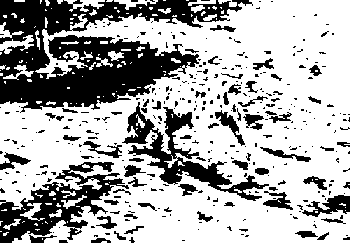
Sometimes expectations can be useful:
www.MichaelBach.de 2004

It would be hard to see the "Dalmation dog" in the figure above if you were not looking for it.

The downside is that our expectations sometimes lead us to see things that are not there. I think we also often miss the beauty of things when they occur in context that departs from our expectations. An elegant example of missing beauty out of context is demonstrated from a recent incognito performance depicted in this video, and in this must read article. As documented the celebrated violinist Joshua Bell performed for free on a 3.5 million dollar violin, yet was mostly ignored by those passing by who were too preoccupied to pay much notice. From the article:

"Watching the video weeks later, Bell finds himself mystified by one thing only. He understands why he's not drawing a crowd, in the rush of a morning workday. But: "I'm surprised at the number of people who don't pay attention at all, as if I'm invisible. Because, you know what? I'm makin' a lot of noise!"
He is. You don't need to know music at all to appreciate the simple fact that there's a guy there, playing a violin that's throwing out a whole bucket of sound; at times, Bell's bowing is so intricate that you seem to be hearing two instruments playing in harmony. So those head-forward, quick-stepping passersby are a remarkable phenomenon"
Another very interesting example of the strange ways that our expectations impact our conceptions of authenticity can be found in the ethically questionable, yet nevertheless interesting and informative documentary by Vikram Ghandi. The name of  the documentary is Kumaré, and this article by Erik Davis describes it nicely.As Davis details:
"Gandhi (his real name) was born in New Jersey and is an alumnus of Columbia University. But in the film he impersonates a long-haired, orange-robed, heavily accented Hindu guru called Sri Kumaré for months on end, gathering a small New Age flock that then witnesses its teacher’s shocking ‘Great Unveiling’ at the close of the film. Gandhi’s experiment is essentially a cruel sceptic’s prank, designed to expose the exotic projections and gullible fantasies animating today’s spiritual seekers."
Prior to his unveiling Gandhi has one primary message for his followers; he is not to be seen as a guru but as an illusion. The true guru is to be found within oneself. This presents an interesting paradox. As Davis puts it:

"Whereas many yogis and other spiritual teachers are arguably more ‘authentic’ in their presence and practice than in their often clichéd rhetoric, Kumaré is most truthful when proclaiming his own status as an illusion. Earnest spiritual teachers, even flawed ones, also want to wake up their students, whereas the awakening of Kumaré’s students to the truth of his illusion becomes, for Gandhi, something of a problem."

Gandhi  is being truthful when he proclaims Kumaré’s guru image an illusion. His followers see this as a great insight, but the insight remains linked to Kumaré’ image as a guru. Does the insight change when Gandhi reveals his deception? Does the revelation render the insight his followers experienced to be more or less authentic?

Yet another example is illustrated in this study, that details the effect that price has on the taste experiance of wine. The study assigned price labels to bottles of wine. The bottles of wine were identical but the price labels ranged from 10 to 90 dollars. Particpants were asked to rate the wines (which they thought were different ) and they also had thier brain activity captured by FMRI while doing the tasting. As expected the participants preferred the wine when a more expensive label was attached to the bottle. Interestingly the FMRI results indicated that this was not a simple cognitive bias preference, but that the particpants actually experienced more pleasure when sipping the same wine with a higher price tag.

The questions relate closely to placebo effects which I plan to post on at some point with reference to the work of Ted Kapchuk.