Monday, February 19, 2018

Harmony Tai Chi - Classes 5 & 6 -


What is most perfect seems shabby and worn, but it is consecrated by use. What is fullest seems empty, a sheer capacity.
What is most true is not level;
what is most skilled is simple;
nothing prospers like poverty;
sincerity is most eloquent.
When it gets cold, move around.
When it gets hot, grow still.
In general, stay calm. (1)

Review

This might be a good time to do a quick thematic review.  Before beginning Tai Chi we prepare a state of readiness (Wu Qi) - what Crispin Sartwells' interpretation of the chapter 45 of the Tao Te Ching refers to as a 'sheer capacity'. The 'Te' part of  'Tao Te Ching' is often translated as virtue, but it can also be thought of as a cultivated power or capacity to respond without force or artifice to the always novel situations we find ourselves entwined within the world. Easy Peasy 😊

Once that is done we orient mind and body to environment with the first movement ( Beginning Tai Chi), and then play with the most basic transformations of yin and yang with the second movement (Grasp the Sparrows Tail). The esoteric third movement (exposition of the mystery) sets the theme for the 1st half (yin section) of the form, and is exemplified in the 5 movements I will cover in this post.


  • Form 4 - Lifting Hands – The Great Straightness Seems Crooked
  • Form 5 - Hidden Tiger – To Give More is to Have More
  • Form 6 - White Crane Spreads it’s Wings – The Great Fullness Seems Empty
  • Form 7 - Brush the Knee –Empty and Yet Productive
  • Form 8 - Playing the Lute – The Greatly Skilled Seems Clumsy


 The Mysterious Theme


So what is this mysterious theme underlying these postures? I have attempted to describe it as a receptivity to something missing in our current pattern of experiencing the world. We all have patterns, habits, beliefs, reflexive ways of feeling, moving, seeing, hearing, or putting things in ideological boxes. The sheer capacity referred to above involves perceiving certain things from perspectives that exceed our first impressions . When those first impressions suggest some degree of possible misalignment with how things really are the natural tendency is ignore that uncomfortable dissonance and try to force things into our patterned ways of perception.


So how might Tai Chi be useful in improving our capacity to harmonize with our situations as they are presented to us as an alternative to always responding with a reflexive patterned response? Well as the philosopher Mark Johnson points out our patterns of response begin (often unconsciously) as bodily feelings. Here he describes one way how dissonance between our world model and our actual situation, in the form of doubt, might present itself:

'As William James pointed out long ago, and Charles Sanders Peirce before him, one’s experience of doubt is a fully embodied experience of hesitation, withholding of assent, felt bodily tension, and general bodily restriction. Such felt bodily experiences are not merely accompaniments of doubt; rather, they are your doubt. The whole meaning of the situation you find yourself in is doubtful. Doubt retards or stops the harmonious flow of experience that preceded the doubt. You feel the restriction and tension in your diaphragm, your breathing, and perhaps in your gut. The meaning of doubt is precisely this bodily experience of holding back assent and feeling a blockage of the free flow of experience toward new thoughts, feelings, and experiences.' (2)
It is not required however that a single feeling or emotion must dominate a situation, stopping the harmonious flow of experience that preceded its appearance. Zhuangzi, in his beautiful passage on 'Cook Ting' describes how a skilled craftsman can deal with doubt when encountering a novel situation. The 'Cook' presented here is really a butcher, a lowly occupation selected by Zhuangzi to emphasize that artistic expression is not restricted by class or status.


' I have been using this same blade for nineteen years, cutting up thousands of oxen, and yet it is still as sharp as the day it came off the whetstone. For the joints have spaces within them, and the very edge of the blade has no thickness at all. When what has no thickness enters into an empty space, it is vast and open, with more than enough room for the play of the blade. That is why my knife is still as sharp as if it had just come off the whetstone, even after nineteen years.“Nonetheless, whenever I come to a clustered tangle, realizing that it is difficult to do anything about it, I instead restrain myself as if terrified, until my seeing comes to a complete halt. My activity slows, and the blade moves ever so slightly. Then all at once, I find the ox already dismembered at my feet like clumps of soil scattered on the ground. I retract the blade and stand there gazing at my work arrayed all around me, dawdling over it with satisfaction. Then I wipe off the blade and put it away.” (3)
I believe the 'blade that has no thickness' is a metaphor for a heart-mind that thinks and feels without coercion and responds freely to the play afforded by its situation. This is a very different conception of freedom from the pure free willing rational faculty often conceived of in west as independent from bodily feeling and emotion. In this passage the 'spaces' within the 'joints' represent the freedom that exists within situational constraints. When that free space for play is diminished as in the encountered 'clustered tangle' the doubt that emerges is embraced ('as if terrified'), but the cook does not let his seeing of the tangle completely separate him from his own developed skill and capacity. His seeing ( which consists of focusing on one piece of the situation ) stops, but his cultivated and embodied heart-mind-blade continues the application of its subtle yet skilled way-making capacity proceeding through the tangle. The successful outcome seems to have emerged through an attunement to the entire situation.

I have gone off on a tangent as I sometimes do which is semi-intentional given that all these concepts are metaphorical and fold back & forth upon each other. But lets get back to the postures covered in weeks 5 &6.


Form 4 - Lifting Hands – The Great Straightness Seems Crooked - 

This movement incorporates both linear and curved movement. The linear aspect looks out from a fixed frame with crossed forearms which then transitions to a curved tracing of the space we can work and play in. It is repeated in two directions and as it completes a complete circle has been traced. The movement can serve to mimic the loop that occurs when we make distinctions from our experience abstracting pieces which always under-determine yet feedback into the ongoing experience. The embodied meaning is captured in the 3rd line of the Tao Te chapter that introduced this post. 'What is most true is not level'.


Form 5 - Hidden Tiger – To Give More is to Have More - 

This is a hidden movement which symbolically represents an early stage of cultivation in which we have yet to discover the gifts we have to offer the world. The tiger theme evolves throughout the 108 postures representing stages in the relationship between the gifts we have to offer and the potential corrupting influences of the ego driven motivations. 

Form 6 - White Crane Spreads it’s Wings – The Great Fullness Seems Empty- 

This is a meditative movement without any stepping. The embodied meaning is captured in the 2nd line of the Tao Te chapter that introduced this post. 'What is fullest seems empty, a sheer capacity'.

Form 7 - Brush the Knee –Empty and Yet Productive- 

Chapter 11 from the Tao Te Ching devotes itself to this idea of an effective absence.
You make a wheel by arranging spokes, but the empty hub receives the axle. You make a vessel from clay, but it's the emptiness that holds things. You build a house from lumber, but you live in the space inside.We work with things and shape the emptiness. (4)

Form 8 - Playing the Lute – The Greatly Skilled Seems Clumsy-  

This posture is about attunement to and acceptance of that which we are ignorant of. It is about finding new ways to experience beauty. I recently read the essay 'Some notes on attunement' by Zadie Smith and found it to be one best descriptions of the way this intended meaning can play out if we allow ourselves to be surprised by new ways of experiencing beauty.

"I hated Joni Mitchell— and then I loved her. Her voice did nothing for me— until the day it undid me completely."
Crispin Sartwell also has a lovely little book (Six Names of Beauty) that that I recommend for providing alternative perspectives for thinking about and learning to appreciate beauty. The first line of the Tao Te chapter that introduced this post describes a type of beauty in Japanese culture known as Wabi Sabi:
 'What is most perfect seems shabby and worn, but it is consecrated by use'  
You can learn more of the Wabi Sabi concept  here.


1. Tzu, Lao. Waterway: a new translation of the Tao Te Ching ( Chapter 45) and introducing the Wu Wei Ching (Kindle Locations 477-483). crispy press. Kindle Edition.
2.  Johnson, Mark. The Meaning of the Body: Aesthetics of Human Understanding (pp. 53-54). University of Chicago Press. Kindle Edition.
3. Zhuangzi; Ziporyn, Brook. Zhuangzi: The Essential Writings, With Selections from Traditional Commentaries (pp. 22-23). Hackett Publishing. Kindle Edition. 
4. Tzu, Lao. Waterway: a new translation of the Tao Te Ching and introducing the Wu Wei Ching (Kindle Locations 151-155). crispy press. Kindle Edition.  
5. Smith, Zadie. Feel Free: Essays (p. 106). Penguin Publishing Group. Kindle Edition.
6.  Sartwell, Crispin. Six Names of Beauty (pp. 83-89). Taylor and Francis. Kindle Edition. 


Thursday, February 15, 2018

Harmony Tai Chi - Class's 3 & 4 - Moving From Absence Into Presence


“Absence, the highest form of presence.” ― James Joyce 
 You can't see the invisible.
You can't name the fugitive.
You can't hear what can't be heard.
You can't grasp what you can't touch.
Now can you?
You can't avoid these qualities, but you can't comprehend them, either.
They make a universe.
Tonight the sky is dark and the earth glows as with moonlight.
A cord stretches from it to it, and returns and returns.
What is the substance of emptiness, the form of the shapeless?
Confront it and its face evades you.
Follow it and its back disappears.
But still the ancients moved with the Tao into presence.
Stay connected to the origin.
That's Tao's cord.
Tzu, Lao. Waterway: a new translation of the Tao Te Ching (chapter 14) and introducing the Wu Wei Ching (Kindle Locations 175-184). crispy press. Kindle Edition.

Double Whip - Exposition of the Mystery

In weeks three and four we only learn one new posture ( Double Whip ). This is a posture/movement that can take quite a long time to master as it requires a simultaneous and subtle integration of multiple Tai Chi principles while stepping and turning the body through the better part of circle. Three years ago I posted on a philosophical connection I saw between the experience of this movement and an essay by Amanda Gefter concerning the Higgs Field ( here ) and I am borrowing some of my on text below.


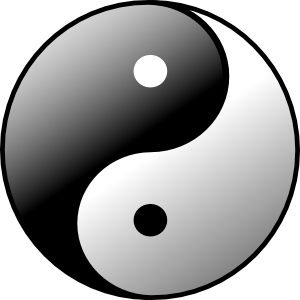
The most basic conceptual principle that is fundamental to Taoist philosophical thought can be described as 'complementary opposition' . This concept is represented by the well recognized tai chi diagram which models the interdependent relationship between yin and yang.  Yin and yang can represent any pair of interdependent complementary opposites such as dark and light, form and formlessness, or, asymmetry and symmetry.


In line with the tai chi diagram, the Ni family harmony style tai chi movement form is composed of two sections: a 58 movement yin section, and a 50 movement yang section. Like the dark and light fish represented in the diagram, the yin and yang sections of the form asymmetrically oppose each other in such a way that their integration allows for the emergence of something greater than the parts. What emerges is symbolized by the symmetrical form of the circle, and what underlies the integration of the parts is a greater symmetry that could be said to be formless.

Consider the two postures 'double whip' and 'single whip'. Common to each of the postures is the underlying meaning 'exposition of the heavenly mystery'. An exposition is the setting forth of a theme. The 'double whip' posture serves this function for the yin section while it's opposing complement 'single whip' serves this function for the yang section. While each of these postures is composed of circular movements the 'double whip' is more contained, less expansive and turns 180 degrees from left to right. In contrast the 'single whip' is less contained, more expansive, and turns from right to left. Like the light dot contained within the dark fish the 'double whip' is said to represent 'yang contained within the yin'. Conversely, the 'single whip' represents the light fish which contains a darkened dot or 'yin within yang'. Together they complete the 360 degree circle of the tai chi diagram.

Moving From Absence Into Presence 

 Embracing emptiness, absence, mystery, uncertainty, and doubt are common theme's in Taoist philosophy. These ideas are not unique to Taoism. Just to give two examples, emptiness is central in Buddhist thought, and the poet Keats' concept of 'Negative Capability'  also has a similar emphasis (1).

'Several things dovetailed in my mind, & at once it struck me, what quality went to form a Man of Achievement especially in Literature & which Shakespeare possessed so enormously — I mean Negative Capability, that is when man is capable of being in uncertainties, Mysteries, doubts, without any irritable reaching after fact & reason'
 My interpretation of the Taoist idea of embracing absence does not require a negation of presence, and neither does the idea of 'being in uncertainties' require a rejection of 'facts & reason'. The ideal embodiment of absence reveals itself as presence. A mind aware of its own uncertainties is properly situated to evaluate facts, apply reason, and perhaps be surprised by new understandings.

There are many distinctions to keep track of while learning the 'Double Whip' movement. The rooted foot connecting one to the earth is constantly changing, the waist (lower dantian) is directing the movement, subtle circular expressions are unfolding out to the extremities, and all the while a visual panorama in flux is being received from above. Any focused attention revealing one of these aspects will conceal all the others. To bring them all into presence we must forget the particulars ( bring them into absence).
 What is the substance of emptiness, the form of the shapeless?
Confront it and its face evades you.
Follow it and its back disappears.
But still the ancients moved with the Tao into presence.
Stay connected to the origin.
That's Tao's cord.


1. https://www.brainpickings.org/2012/11/01/john-keats-on-negative-capability/

Wednesday, February 14, 2018

Harmony Tai Chi - Class 2


 'The world is like a bow being drawn;
what is high comes down, and what is low rises.
What is lacking gets filled; what is full leaks into the emptiness.
The world threatens those who have too much and yields its real wealth to those who have nothing.
Yet human beings try to operate in exactly the opposite way.
We give power to those with power and take it away from those who don't have any.
Good luck!
The path always returns.'

Tzu, Lao. Waterway: a new translation of the Tao Te Ching (Chapter 77 )  (Kindle Locations 760-766). crispy press. Kindle Edition.


Form #2 - Grasp the Sparrows Tail - Gate of Subtle origin

We begin this class first by reviewing what we worked on in week 1 and next we move forward with the 2nd movement form.

The 2nd movement 'Grasp the Sparrows ' is comprised of four smaller movements each with its own common name, and with its own spiritual or poetic meaning attributed from the Ni family tradition. These four smaller movements were also each among the 13 original Tai Chi postures attributed to Chan San Feng, and as such they have classic correspondences with yin/yang and five element theory. The table below lays out these correspondences.


The Four Components of Grasp the Sparrows Tail
Common name
Ni Family Spiritual Meaning
Tai Ji Classics Correspondence
Brush the Sleeve
to raise the lower
pure yang, heaven, creativity
Roll back
to lower the elevated
pure yin, earth, receptivity
Press
decrease the overabundant
yang within yin, water
Push
nourish the insufficient
yin within yang, fire


The attentive reader may at this point have noticed how the Ni family meanings mesh nicely with the quoted chapter (#77) from the Tao Te Ching that introduces this post. This is a small example of how the Ni family form meanings provide a depth of philosophical background that can enrich ones engagement with the movement. 

Each individual posture meaning much like the individual notes in a musical composition can take on a collective significance in the context of those meanings that surround it. As this collective significance takes and sheds form, the contours of its shape unfolds in a long progression of the movement. The meanings like the notes, reveal their beauty in relation to those that came before, the silence in between, and the suggestion of those to come. Ultimately, the meanings in the long form trace a path of cultivation that folds back against itself, and each time one practices the form she does so as a new beginner, although perhaps starting at a different point along the circle.

In this particular example the Ni family meanings refer to fundamental transformations between yin and yang. For example the Ni family represents a long line of traditional Chinese medicine practitioners, and the four most fundamental techniques in acupuncture include:


  1.  learning to support the body in lifting energy when its yang rising capacity is diminished:
  2.  learning to lower energy which is unrooted and floating upwards;
  3.  sedating excessive energetic expressions such as inflammatory processes
  4.  tonifying areas of weakness or deficiency.
    Of course these medical applications are just one way the metaphors could be applied.


Collectively the four components fall under the larger form meaning 'The Gate of Subtle Origin'. This can be thought of as a gate swinging back and forth between the limitless variations of yin and yang connected on their pivot point, and always part of a larger continuum.


The Gate of Subtle origin and Zhuangzi's Pivot of the Tao


The center point from which the 'Gate of Subtle Origin'  swings was described by my favorite Taoist philosopher Zhaungzi with a metaphor he termed 'the Pivot of Tao'. Here is one example:

'When “this” and “that”—right and wrong—are no longer coupled as opposites—that is called the Course as Axis, the axis of all courses.When this axis finds its place in the center, it responds to all the endless things it confronts, thwarted by none. For it has an endless supply of “rights,” and an endless supply of “wrongs.” Thus, I say, nothing compares to the Illumination of the Obvious. (1)
....Thus, the Sage uses various rights and wrongs to harmonize with others and yet remains at rest in the middle of Heaven the Potter’s Wheel.This is called  “Walking Two Roads.' (2)
I should mention here that the character 'tian' which is translated as 'Heaven' does not resemble the concept of heaven familiar in the modern world. It is often translated simply as nature instead. The 'potters wheel' is a metaphor for the spontaneous unfolding of nature's events and processes. Walking two roads is a metaphor for moving with the 'Tao'.

Walking two roads is what we try to do in Tai Chi practice. We want to keep our options open, finding a space of play between the extremes. From this space of free play we hope to see the possibilities afforded in a given situation without blinding ourselves to those possibilities with fixed prior allegiances. This is an aspect of moderation in that it involves not going to extremes, but it shouldn't be interpreted as staying passive in the middle. Rather than passivity, it is a posture of engaged responsiveness.

Notice the phrase 'the Sage uses various rights and wrongs to harmonize with others'. This is also not solipsism, or an enclosed, or self created reality purely of our own choosing. Having access to the supply of 'rights' and 'wrongs' requires a fluency of understanding responsibly connected to the physical, social, and cultural environments that produce the rolling situations we are embedded within. Perhaps most important is developing an awareness that is equally concerned with the the power of self deception as it is with self actualization, equally embracing our own uncertainties and illuminations with humility.
'Thus, the Radiance of Drift and Doubt is the sage’s only map. He makes no definition of what is right but instead entrusts it to the everyday function of each thing. This is what I call the Illumination of the Obvious.' (3)
 
Some might also be interested in a post I created 5 years ago that concerns the of idea of nature filling what is empty, taking away from the excessive and in general moving things towards an equilibrium. I called it the 'Tao of Entropy'.


1,2,3. Zhuangzi; Ziporyn, Brook. Zhuangzi: The Essential Writings, With Selections from Traditional Commentaries (Hackett Classics) (p. 12&14&15). Hackett Publishing. Kindle Edition.